The question Where to buy Acetonitrile HPLC solvent online in the USA is often asked by laboratories that can find a reliable supplier. In the sourcing of solvents, it is necessary to check:
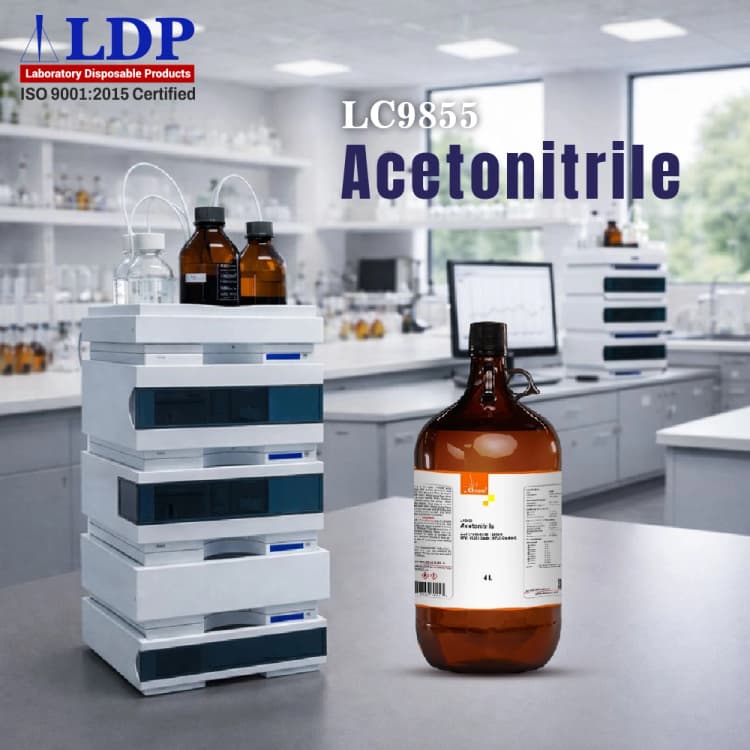
Acetonitrile HPLC solvent: Essential High-Purity Mobile Phase for Chromatography
On Monday, 19 January 2026
The quality of solvent directly affects the accuracy and reproducibility of chromatography in analytical and research laboratories. One of the most commonly used mobile phase solvents in high-performance liquid chromatography is acetonitrile HPLC solvent since it has an excellent purity, a low UV absorbance, and a high elution strength. In quality control of pharmaceuticals and in higher educational studies, this solvent is extremely important in providing accurate and dependable results.
HPLC-grade Acetonitrile is widely used by laboratories that want to achieve high-quality analytical results and need to comply with strict method validation and regulatory standards.
What is Acetonitrile HPLC solvent?
Acetonitrile is a polar aprotic organic solvent having a chemical formula of CH3CN. Acetonitrile HPLC is a specialized solvent that is prepared and purified to be used in chromatography and has low traces of water, UV-absorbing impurities, and non-volatile impurities.
HPLC-grade Acetonitrile offers greater stability in baselines and reduced interference at detection and is therefore a good high-purity chromatography solvent in both routine and advanced HPLC analysis compared to lower grades.
The important Properties of HPLC-grade Acetonitrile.
Acetonitrile HPLC solvent is very popular because of the following good physicochemical characteristics:
The cutoff of the UV is low, and is suitable for UV and PDA.
Minimal viscosity, minimizing the column backpressure.
Maximum elution forces to enhance peak resolution.
Very good aqueous and buffer systems miscibility.
Very volatile, and therefore easy to remove.
These characteristics enable HPLC-grade Acetonitrile to be used in high-precision chromatographic processes.
Uses of Acetonitrile HPLC solvent in Laboratories.
Acetonitrile HPLC solvent has a wide range of applications in analysis, among which are:
- Reverse-phase HPLC mobile phase preparation
- Gradient elution methods.
- Pharmaceutical analysis of API and impurities.
- Bioanalytical and clinical analysis.
- The analysis of food and beverage contaminants.
- Chemical and environmental studies.
It is a highly sought-after high-purity chromatography solvent that is highly versatile and consistent, and can be used in regulated and non-regulated laboratories alike.
Acetonitrile vs. Methanol in HPLC Applications
Although methanol is usually employed in chromatography, Acetonitrile HPLC solvent is usually better behaved. The acetonitrile gives a smaller system backpressure, faster run times, and has a better peak shape and resolution. In the case of high-sensitivity and efficiency methods, HPLC grade Acetonitrile is often used.
Importance of High-Purity Acetonitrile for Chromatography
Poor solvents may lead to ghost peaks, drift base lines, and damage to columns. The choice of a solvent in Acetonitrile HPLC:
Constantly stable and noise-free baselines.
Better method reproducibility.
Extended column life
Verified and valid analytical information.
That is why in labs, the high-purity chromatography solvents are the focus of crucial tests.
LiChrom HPLC Solvents for Reliable Performance
LiChrom HPLC solvents can be designed to fulfill high standards of chromatographic purity. These solvents are designed to be used regularly with other lots and have been proven to be used in the pharmaceutical, academic, and industrial laboratories to perform high-accuracy analysis. The LiChrom products, when employed as an Acetonitrile HPLC solvent, are useful in ensuring the integrity of the methods and confidence in the analysis.
Storage, Handling, and Safety Take into Account.
To maintain the quality of solvents and to maintain laboratory safety:
- Store Acetonitrile HPLC solvent in well-closed containers.
- Protect against moisture and heat sources.
- Well-ventilated laboratory usage.
- Use proper guidelines for handling chemicals and disposal.
Correct storage can be used to preserve the integrity of HPLC-grade Acetonitrile.
Where to buy Acetonitrile HPLC solvent online in the USA
Confirmed HPLC grade certification.
Certificate of Analysis (COA) is available.
Uniform purity and packaging.
Trustworthy supply chain operation.
LDP offers reliable information to the laboratories intending to buy Acetonitrile HPLC in the USA.
Best Acetonitrile HPLC solvent for chromatography at LDP
The best Acetonitrile HPLC solvent that can be used in chromatography must focus on the purity, consistency, and reliability of the supplier. LDP provides HPLC-grade Acetonitrile and LiChrom HPLC solvents that are carefully sourced to enhance the reproducible and accurate chromatographic analysis in a vast application spectrum.
Frequently asked questions: Acetonitrile HPLC solvent.
It is a mobile phase solvent mostly used in HPLC in pharmaceutical, environmental, food, and research applications.
Its UV cutoff is low, so it is also best to use it in UV and PDA detector systems.
Purity of high level eliminates interference, enhances reproducibility, and preserves HPLC columns.
Yes, LiChrom HPLC solvents are prepared to achieve rigorous purity standards of analysis.
It must be placed in tightly closed containers, out of heat and moisture, in a well-ventilated area.
Conclusion
The selection of the HPLC solvent, acetonitrile, is very important in obtaining reliable and reproducible chromatographic results. High-purity HPLC-grade Acetonitrile has continued to play a central role in state-of-the-art analysis laboratories due to its high purity, performance, and applicability. Through the sourcing of quality products using LDP, the laboratories will be able to be confident in their accuracy and consistency in all the analyses.
Disclaimer: All the information on this blog is published in good faith and for general information purposes only. The information contained in this blog might be provided on an “as is” based on Wikipedia, Google, and other scientific articles. We are not liable for any injuries or damages for the use of the information. Please do your research before you use this information for any purpose.