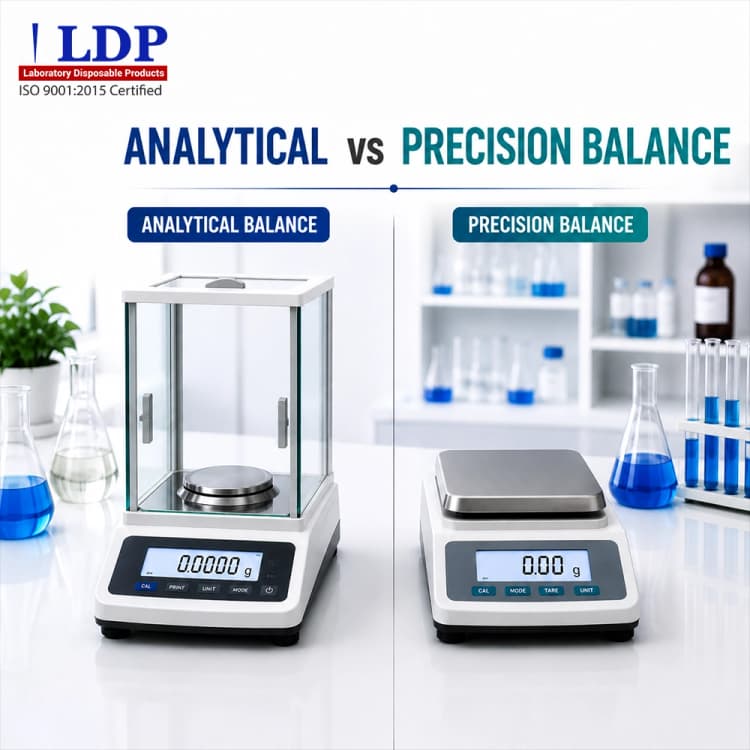
Analytical vs Precision Balance, Which One Is Right for Your Lab
On Monday, 03 August 2026
Measuring accuracy is essential for any work in the laboratory, and the balance you choose is often taken for granted. Regardless if you are a researcher in the pharmaceutical field, or in quality control, knowing the difference between an analytical vs precision balance is crucial.
Here, we'll look at analytical vs precision balances, their characteristics, and, more importantly, how to select the right lab balance for your lab needs.
What Are Analytical and Precision Balance?
Let's first define the terms before we talk about analytical vs precision balance.
Analytical and precision balances are two types of balances used in the lab with varying degrees of accuracy.
Accuracy of the analytical balance: For very sensitive weighing with a precision of 0.0001 g (0.1 mg).
Precision balance accuracy range: Used for less sensitive measurements, with a precision of 0.01 g to 0.001 g (10 mg - 1 mg).
The primary difference between analytical and precision balances is their sensitivity and application.
Common Features of Analytical and Precision Balances
Analytical and precision balance equipment have some similar features, but different capabilities.
But in analytical vs precision balance, analytical balances may have draft guards to avoid air drafts, to enhance the Accuracy of the analytical balance.
Analytical vs Precision Balance: Key Differences
The analytical vs precision balance comparison aids in laboratory decision-making.
1. Accuracy and Measurement Sensitivity
The Accuracy of the analytical balance is much better thanks to the detection of micro-level changes. It has a higher measurement sensitivity, which is suitable for measuring small quantities.
In contrast, the precision balance accuracy is enough for general lab work where high-precision measurements are not needed.
2. Capacity of an analytical and precision balance
The other key difference in the capacity of an analytical and precision balance.
So, analytical and precision balance capacity is determined by your application.
3. Factors affecting weighing accuracy
For both balances, there are many Factors affecting weighing accuracy:
However, analytical vs precision balances differ because analytical balances are more sensitive to these environmental conditions.
Comparison Table: Analytical vs Precision Balances
| Feature | Analytical Balance | Precision Balance |
|---|---|---|
| Accuracy | Very high (0.0001 g) | Moderate (0.01 g–0.001 g) |
| Measurement Sensitivity | Extremely sensitive | Less sensitive |
| Capacity | Low | High |
| Environment | Controlled | Flexible |
| Application | Research, pharma | Routine lab work |
This table simplifies the analytical vs precision balance comparison for quick understanding.
Which Balance is Right for You?
If you are still confused about which is better, analytical or precision balances, consider these tips:
1. Consider the Required Accuracy
If you need the highest possible accuracy of an analytical balance, such as in chemistry and pharmaceuticals, choose an analytical balance.
2. Consider Capacity Requirements
A precision balance is more appropriate for weighing large samples as the capacity of an analytical and precision balance is high.
3. Look at the working environment.
If you don't have control over it, a precision balance might be more accurate.
4. Application matters.
Knowing your application is important for choosing between an analytical and a precision balance.
How to Choose the Right Lab Balance
There are several factors to consider when choosing a balance:
Ultimately, understanding the balance between analytical and precision ensures you invest in the right equipment without overspending.
Where to Buy Analytical and Precision Balances
When purchasing an analytical and precision balance, it's crucial to select the right supplier as well as the right equipment. The quality of the product, its reliability and the level of service and support can make a big difference in your lab.
It is always best to buy lab equipment from a trustworthy and well-known supplier. A trustworthy supplier will not only have a wide range of analytical and precision balances, but they will also help you choose the right one for your needs, level of sensitivity, and budget.
At Laboratory Disposable Products (LDP), we offer high-quality lab equipment that meets modern standards. Our analytical and precision balance systems will always work well, give you accurate results, and last a long time. Laboratory Disposable Products (LDP) has the right balance for you, whether you need one for research, pharmaceuticals, or regular lab work.
Conclusion
Factors such as accuracy, capacity and application are key to determining analytical vs precision balance. Analytical balances are the most precise but precision balances are versatile and have greater capacity. Comparing the capabilities of analytical and precision balances, the precision balance accuracy range and Factors affecting weighing accuracy can help you choose the right balance for your laboratory.
FAQs
Disclaimer: All the information on this blog is published in good faith and for general information purposes only. The information contained in this blog might be provided on an “as is” based on Wikipedia, Google, and other scientific articles. We are not liable for any injuries or damages for the use of the information. Please do your research before you use this information for any purpose.