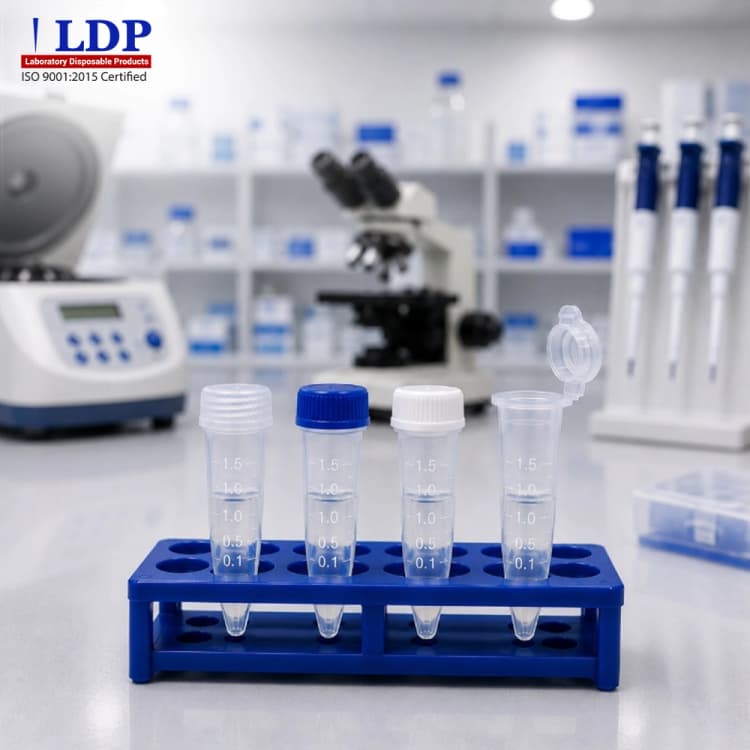
Microcentrifuge Tubes: Types, Materials, and Applications
On Monday, 17 August 2026
Sample handling products are essential to the accurate, safe and efficient conduct of laboratory analysis in a lab environment. Microcentrifuge tubes is one of the essential lab consumables which are used for sample storage, centrifugation, molecular biology testing and analytical research applications. These smaller laboratory tubes deliver a high-speed centrifuge capable test tube, which offers safe, secure containment of precious biological and chemical samples both during lab operations and the high-speed centrifuge process.
This blog provides valuable insights on the different types of laboratory microcentrifuge tubes, their materials, and use in molecular biology, pharmaceutical, clinical, and research laboratories. It also outlines the parameters for accurate and reliable sample handling as well as information on sample types that need to be tested, performance of centrifugation ratings, chemical resistance and laboratory needs to select appropriate handling tubes.
What Are Microcentrifuge Tubes?
Microcentrifuge tubes are small plastic laboratory tubes for the storage, processing, mixes and centrifugation of liquid samples in scientific labs. Common types of tubes are 0.5 mL, 1.5 mL, and 2.0 mL (small sample sizes used in laboratory tests).
Microcentrifuge tubes are produced using high-quality materials for strength, leak-proof nature, temperature resistance and use in various systems of centrifugation. These are widely used in biotechnology, pharmaceuticals, academics, the environment, and clinical laboratories for routine sample preparation and testing procedures.
Types of Microcentrifuge Tubes
High-quality laboratory microcentrifuge tubes require a proper tube design and closure systems that are suitable for the good management of the sample safety and flow.
Snap Cap Tubes
One of the most common types of microcentrifuge tubes in lab is snap cap tubes. They come with built-in hinged caps that help in sealing and are very convenient to use for routine tasks in laboratories. Their open and close mechanism makes them very convenient to use for routine testing applications.
Common uses include:
DNA and RNA sample preparation.
Protein separation procedures.
Laboratory mixing/centrifugation.
Highly standardized biological testing processes.
Screw Cap Tubes
Screw cap tubes provide a higher level of sealing protection than snap cap tubes do. These types of laboratory microcentrifuge tubes, which are designed to keep specimens safe when they require transportation or long-term storage in a lab environment as well as cryopreservation.
Applications include:
Cryogenic sample storage.
Transportation of laboratory specimens.
Pharmaceutical testing procedures.
Chemical storage applications.
Graduated Tubes
Microcentrifuge tubes are graduated as measurement stripes printed on each tube to allow laboratory professionals to conduct precise liquid handling operations during dilution, preparation, and testing stages.
Sterile and Non-Sterile Tubes
Sterile laboratory tubes are designed to reduce the risk of contamination in molecular biology and microbiology applications by producing them under controlled conditions. Non-sterile microcentrifuge tubes are usually applied to everyday laboratory functions where sterility isn't essential.
Materials Used in Laboratory Tubes
The quality of material used in the production of the laboratory tubes is significant in regard to chemical resistance, durability, transparency and temperature stability.
Polypropylene (PP)
Microcentrifuge tubes are usually constructed from polypropylene, which has superior chemical resistance and can withstand high centrifugal forces. These tubes are lightweight, durable, and can be used for low-temperature storage applications as well as heating applications.
Benefits of polypropylene tubes include:
Excellent durability during centrifugation.
Strong chemical resistance.
Low sample binding properties.
High clarity for visibility of the sample.
Suitable for freezing applications.
Polyethylene (PE)
Polyethylene tubes are flexible and lightweight and will work for a few low-speed laboratory applications. They are, however, not as resistant to higher temperatures and chemicals as polypropylene microcentrifuge tubes can be.
Low-Binding Materials
Low-binding is a special feature of some advanced laboratory tubes that minimizes sample loss in protein and nucleic acid applications. These special products are very useful in sensitive molecular biology processes.
Applications of Microcentrifuge Tubes in Modern Laboratories
The versatility, convenience and compatibility with modern laboratory equipment make microcentrifuge tubes indispensable in a variety of scientific industries.
Molecular Biology Laboratories
These tubes are utilized in molecular biology workflows for DNA extraction, RNA purification, PCR preparation, enzyme reactions, and sample storage procedures. They are designed to be contamination-resistant so that experiments can be relied upon.
Clinical and Diagnostic Testing
Sample handling tubes are used in clinical laboratories to prepare blood samples, analyze urine, and for other diagnostic testing applications, and for specimen centrifugation.
Pharmaceutical Research
Laboratory microcentrifuge tubes are used by pharmaceutical companies for formulation studies, quality control testing, pharmaceutical development procedures, and analytical research workflows.
Microbiology Applications
Centrifuge sample handling tubes are used in microbiology laboratories for preparing bacterial cultures, microbial analysis and sample separation.
Chemical and Analytical Laboratories
Microcentrifuge tubes are used for chemical preparation, reagent storage, chromatography testing and laboratory research applications, which are executed by analytical laboratories.
How to Choose the Right Laboratory Microcentrifuge Tubes
The choice of laboratory microcentrifuge tubes plays a critical role in laboratory efficiency and accurate test results.
Some things to take into consideration are:
Material compatibility with chemicals.
Required centrifugation speed.
Temperature resistance requirements.
Tube sealing capability.
Sterility requirements.
Volume capacity needs.
Compatibility with laboratory equipment.
High-quality laboratory microcentrifuge tubes can improve sample protection, reduce contamination rates, and benefit the workflow of your laboratory.
Why choose Laboratory Disposable Products (LDP) for Microcentrifuge Tubes?
Laboratory Disposable Products (LDP) is a trusted supplier of laboratory consumables and scientific products to research, pharmaceutical, clinical and industrial laboratories throughout the USA. Laboratory Disposable Products (LDP) provides a comprehensive selection of the best microcentrifuge tubes for laboratory use and high-quality laboratory consumables in the USA, including sample handling products, bottles, containers, pipettes and centrifuge accessories that are designed to ensure the smooth operation of laboratory processes and the precision of testing procedures.
Conclusion
Microcentrifuge tubes are the basic laboratory consumables for laboratories, in research, clinical, pharmaceutical and analytical applications. They can safely store and process small samples of liquids, making them very useful for today's science workflows. Laboratories use appropriate tubes and materials to ensure that the tests are conducted with accurate, repeatable and uncontaminated results. With laboratory technology continually progressing, durable and high-performance sample handling products are essential to effective scientific research and accurate analytical testing.
FAQs
Disclaimer: All the information on this blog is published in good faith and for general information purposes only. The information contained in this blog might be provided on an “as is” based on Wikipedia, Google, and other scientific articles. We are not liable for any injuries or damages for the use of the information. Please do your research before you use this information for any purpose.